
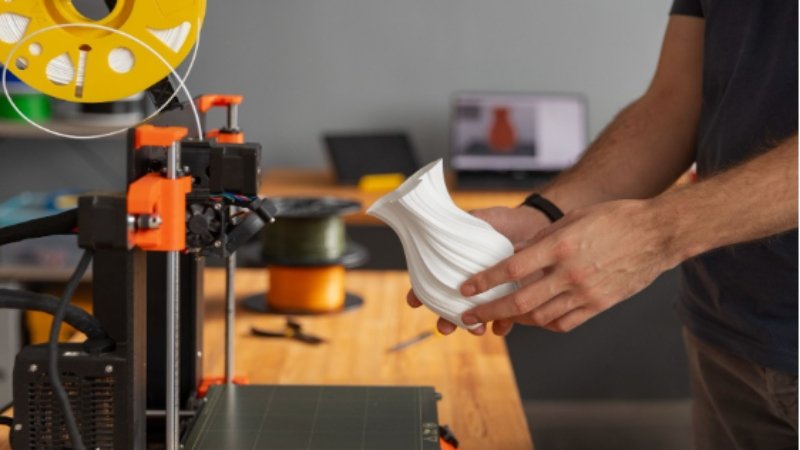
Getting parts manufactured shouldn’t feel like you’re cracking some impossible code. Either way, custom 3d printing services let you take a digital design and make it tangible, no lengthy tooling delays, no eye-watering setup fees that traditional factories love to charge.
Here’s something that’ll grab your attention: companies tapping into 3D printing tech are slashing prototyping timelines, with many seeing development cycles shrink by half or more. That kind of velocity explains the surge among engineers, product folks, and procurement pros who lean on on-demand 3D printing for everything from proving out concepts to filling gaps between pilot runs and full production.
You’ll discover how to match the right tech and materials to your needs, whether you’re hunting for a 3D printing service near me or going digital, and how to bundle your specs into an RFQ that eliminates confusion and wasted time.
Custom 3D Printing Services vs In-House Printing (Decision Framework for Buyers)
Purchasing your own printer looks tempting until reality introduces you to the hidden baggage. Industry data shows that companies weaving 3D printing into electronics manufacturing achieved positive ROI between 12 and 18 months post-implementation. But that timeline assumes consistent volume, operators who know their stuff, and a solid maintenance game plan. Most teams? They’re missing at least one of those pieces.
Best-fit scenarios for a 3D printing service (prototype → production)
A custom 3D printing services shines when your needs include quick prototypes, one-off replacement bits, jigs, fixtures, display models, or modest quantities of functional parts. These shops handle the gap between prototype and mass production without forcing you to sink cash into tooling or commit to minimum order quantities that make your CFO nervous. You get the freedom to iterate on designs, test variations side-by-side, and confirm fit before scaling up.
Hidden costs of owning printers vs using on-demand 3D printing
Ownership means you’re paying for calibration, upkeep, prints that fail (and they will), proper ventilation, post-processing labor, storing materials correctly, and depreciation. When a bureau spreads all those expenses across their entire customer base, they frequently beat you on both total cost and turnaround, especially for sporadic jobs or geometrically complex parts.
Lead time + risk comparison (shipping, reprints, revisions)
Standard service times typically land between five and ten business days; rush it,t and you’re looking at two or three. The good ones offer DFM feedback and quality checks that dramatically lower your odds of receiving parts that don’t mate properly. Sure, shipping adds days. But getting reprints and revisions handled through a bureau usually outpaces waiting for your own machine queue to free up.
Now that the “why outsource?” The question is settled, let’s trace the journey your CAD file takes from upload to doorstep.
Custom 3D Printing Service Workflow (From Upload to Delivery)
File prep that prevents delays (STL/3MF/STEP + tolerances)
STEP files keep your engineering intent intact. STL and 3MF work great for mesh-driven processes. Double-check units, scale, that the geometry’s actually watertight, and minimum wall thickness. Attach print notes: which surfaces matter most, load direction, and features that have to mate with other components. Clear communication upfront eliminates the email tennis that eats your schedule.
Quoting process inside a modern 3D printing service
Automated quotes handle straightforward geometries. Complex assemblies and tolerance-critical designs get an engineer’s review. DFM analysis catches overhangs, walls that are too thin, trapped material (powder or resin), strength issues from print orientation, and support marks before you’re locked in.
Production planning (orientation, supports, nesting, batch strategy)
How your part sits in the machine affects both strength and surface quality. Nesting is how SLS and MJF shops pack multiple pieces into one build to drive cost down. Support strategy is always a balancing act with FDM, SLA, and DLP. More support means easier builds but longer cleanup afterward.
Printing + in-process monitoring (quality controls that matter)
Solid QC includes calibration logs, material batch tracking, and dimensional checks at key milestones. Some shops deploy AI monitoring and cameras to spot layer shifts or blob formation, though no system catches everything before it happens.
Post-processing menu (finish, fit, and function)
Stripping supports, UV curing, depowdering, sanding, bead blasting, dyeing, vapor smoothing, CNC cleanup, thread tapping, and heat-set inserts. All these steps determine whether your part merely looks right or actually works. Add-ons like press-fit assembly, magnets, or hardware installation turn raw prints into drop-in components.
Final inspection + packaging (functional vs cosmetic acceptance)
Dimensional verification ranges from simple calipers all the way up to CMM or full 3D scanning. Smart packaging protects fragile resins and prevents warping during transit for longer FDM pieces.
Walking through the workflow reveals something crucial: one of your earliest decisions, choosing print technology during the quote phase, has an outsized impact on function, finish, and budget.
Choosing the Right Technology in Custom 3D Printing Services (Fast Match Guide)
FDM/FFF for affordable functional parts and fast iterations
Ideal for brackets, tooling, large components, and when surface finish isn’t make-or-break. Watch out for visible layer lines, directional strength differences, and marks where supports are touched.
SLA/DLP/MSLA for high-detail prototypes and smooth finishes
Perfect for miniatures, dental patterns, jewelry masters, and cosmetic enclosures. Be aware of UV degradation over time, brittleness in some resins, and the need for post-cure steps.
SLS/MJF for durable nylon parts without support structures
Excellent for snap-fits, living hinges, lattice designs, assemblies with complexity, and parts that need to perform like production. Trade-offs include slightly grainy surfaces and constraints on minimum features.
Picking the right process gets you halfway there. Matching it with the correct material determines whether your part survives real conditions or fails spectacularly.
Materials That Perform (Selection by Use Case, Not Hype)
Plastics for strength, heat, and impact (PLA, PETG, ABS, ASA, Nylon)
Indoor or outdoor use? UV exposure? Operating temperature? Impact loads? All these factors drive material selection. Ignore the marketing fluff demanding actual datasheets.
Engineering polymers (PC, PA-CF, PEEK/PEKd) were offered
These materials dominate when you need heat resistance, stiffness, or chemical compatibility. Not every bureau can reliably print high-temp polymers, so verify their track record before committing.
Once you’ve identified candidate materials, the inevitable question surfaces: “What’s this going to cost me?” and getting a real answer means looking past the headline number.
3D Printing Cost Explained (Accurate Estimating + Cost Cutting Without Sacrificing Quality)
Understanding 3D printing cost means dissecting the quote: setup plus machine time, material consumption, support structures, finishing work, inspection, shipping, and potential revisions all factor in.
Geometry-driven pricing factors (the real reasons your quote is high)
Tall vertical dimensions, thick walls, high-density infill, heavy support requirements, tight tolerances, and cosmetic finishing demands all inflate the price. Small tweaks, hollowing interiors, strategic lattice use, and orientation shifts can drop costs substantially and fast.
Practical strategies that reduce cost fast
Hollow designs with drain holes for resin, lattice infill where stress allows, smart orientation changes, relaxing non-critical tolerances, splitting and reassembling oversized parts, minimizing support-heavy features, batching orders together, and standardizing design elements across product lines all save real money without compromising what matters.
With cost expectations calibrated, your next strategic call is *where* to order: should you search for a 3D printing service near me for rapid turnaround, or leverage the deeper capabilities of on-demand 3D printing platforms?
“3D Printing Service Near Me” vs Online Ordering (Speed, Privacy, and Quality Tradeoffs)
Local 3D printing service near me: best scenarios
Same-day pickup, in-person fit iterations, proprietary assemblies, and direct conversations make local shops invaluable when deadlines are brutal or you need collaborative problem-solving.
Online on-demand 3D printing: best scenarios
Access to advanced processes, SLS, metal, specialty resin,s combined with competitive pricing through distributed capacity and standardized QA, makes online platforms the smart play for complex technical requirements and repeat business.
Local or online, what ultimately counts is parts arriving on-spec and assembly-ready,ady which demands understanding realistic tolerances and mechanical behavior from the start.
Quality, Tolerances, and Fit (Getting Parts That Assemble the First Time)
Tolerance reality by process (designing for real-world accuracy)
FDM generally holds ±0.015 inches, SLA around ±0.005 inches, SLS approximately ±0.012 inches, and metal ±0.005 inches,ches but shrinkage and warpage can mess with those numbers. Ask providers for process-specific guidelines and how they compensate during production.
With tolerances, finishes, and material behavior clear, you’re ready to package everything into a crisp order that avoids revisions and schedule slippage.
Order-Ready Checklist for Custom 3D Printing Services (Paste Into Your RFQ)
Include: part purpose (prototype or production use), expected loads and operating temperature, environmental exposure (UV, chemicals), preferred process and material, critical dimensions with tolerance callouts, mating surfaces, datum references, finish requirements (functional versus cosmetic), color preferences, post-processing needs, quantity now plus future forecast, delivery deadline, shipping address, and attachments (STEP plus STL/3MF, drawings as PDF, reference photos of mating components if replacement).
Theory gets real when you watch teams across industries apply this framework to tackle actual challenges from design iteration to critical replacement components.
Final Thoughts on Custom 3D Printing Services
Custom 3d printing services bridge the chasm between concept and reality without equipment overhead or traditional manufacturing lead times. Grasping the workflow, technology landscape, material trade-offs, and cost mechanics empowers you to make sharper, faster sourcing calls. Whether you’re iterating prototypes or running small batches, the right partner transforms complexity into confidence and turns ideas into parts that work right out of the box. At Disquantified.com, we believe that true creativity starts with the heart. And when shared with purpose, it can leave a lasting mark.
Common Questions About Custom 3D Printing Services
What are custom 3D printing services, and when should I use them?
They convert digital files into physical objects layer by layer. Perfect for prototypes, low-volume runs, and complex shapes that conventional methods can’t touch economically.
How much does a 3D printing service cost for a single part?
Basic FDM parts start at around ten to fifty dollars. SLA runs twenty-five to a hundred. SLS hits fifty to two hundred. Metal? North of two hundred. But geometry, finish, and tolerance requirements drive final cost more than the technology itself.
Is “3D printing service near me” better than ordering online?
Local wins when you need same-day pickup and iterative fit validation. Online wins for broader tech access, competitive pricing, and consistent quality across repeat orders.