
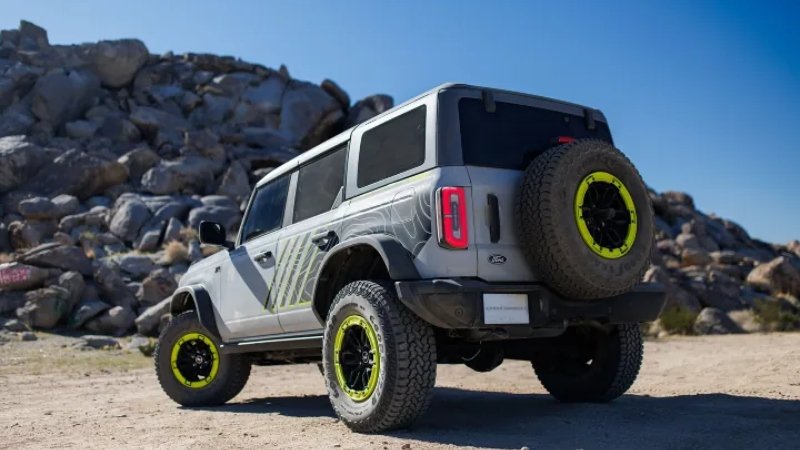
The modern off-road SUV market is loud. Lift kits, beadlock wheels, aggressive lighting, roof racks that look ready for a week-long expedition even if they’re mostly hauling groceries. In the middle of all that visual noise, the RTR Ford Bronco manages to stand out without feeling like it’s trying too hard.
Which brings us to the question many enthusiasts keep asking: is RTR Ford Bronco simply another styling package, or is there something deeper going on beneath the widened stance and purposeful details?
To answer that, you have to look past the surface. Because the real story isn’t just about how it looks it’s about how it was designed.
Design With Intent, Not Decoration
At first glance, the RTR Ford Bronco looks exactly how you’d expect a performance-oriented off-road SUV to look: muscular, assertive, and ready for uneven terrain. But design philosophy isn’t about appearance alone. It’s about intention.
RTR short for “Ready to Rock” has always leaned into purposeful performance. That philosophy carried over from their Mustang builds into the Bronco platform. The goal wasn’t to overwhelm the base vehicle. It was to amplify what already worked.
The Bronco has strong design bones: upright proportions, short overhangs, wide track, and removable panels. RTR’s approach wasn’t to reinvent those fundamentals. It was to refine them.
And that distinction matters.
The Balance Between Aggression and Restraint
One of the more interesting aspects of the RTR Ford Bronco is how it manages aggression without tipping into exaggeration.
Visual Presence Without Excess
Many off-road builds pile on accessories until the vehicle feels cluttered. RTR’s additions whether in wheel design, body elements, or stance feel cohesive. The lines still flow. The Bronco silhouette remains recognizable.
That’s not accidental.
Good design philosophy asks a simple question: “Does this enhance the identity of the vehicle?” If the answer is no, it doesn’t make the cut. That restraint is what separates a factory-backed performance build from a backyard experiment.
Function Drives Form
Design is most compelling when it serves a purpose. On the RTR Ford Bronco, visual upgrades often have functional reasoning behind them.
Wider stance improves stability. Tire choices reflect actual off-road capability. Suspension tuning is engineered to perform not just to look tall in a parking lot.
The aesthetic and mechanical elements aren’t competing with each other. They’re aligned.
And alignment is a sign of thoughtful engineering.
Respecting the Bronco’s Heritage
The Ford Bronco name carries decades of off-road credibility. Any modern interpretation has to acknowledge that history without becoming trapped by it.
RTR’s design philosophy seems to embrace this balance.
The Bronco already blends retro inspiration with contemporary engineering. RTR builds on that duality adding modern performance character while respecting the vehicle’s utilitarian roots.
It doesn’t try to turn the Bronco into something it’s not. It sharpens what it already is.
Engineering for Real-World Adventure
Off-road vehicles live complicated lives. They might tackle trails one weekend and commute through traffic the next. Design philosophy has to account for both realities.
Everyday Usability Matters
One of the most overlooked aspects of performance SUV design is comfort. It’s easy to tune suspension for extreme articulation and clearance. It’s harder to maintain drivability in daily conditions.
RTR’s approach suggests that capability shouldn’t come at the expense of usability. The Bronco RTR still functions as a practical vehicle. Doors open normally. Cabin ergonomics remain intuitive. Visibility stays strong.
You don’t need to “endure” it to enjoy it.
That dual-purpose design is intentional, not accidental.
Factory-Backed Confidence Changes the Equation
The design philosophy behind the RTR Ford Bronco is influenced heavily by its factory-supported nature.
When modifications are integrated at a high level rather than added post-production they can be calibrated, tested, and validated as a complete system.
This results in:
- Balanced performance
- Integrated electronics
- Harmonized suspension geometry
The Bronco RTR isn’t a collection of parts. It’s a coordinated package. That integration reflects a mindset focused on cohesion rather than experimentation.
Emotional Design Still Matters
Let’s be honest for a moment. No one buys a vehicle like this purely for spreadsheets.
Off-road SUVs are emotional purchases. They represent freedom, capability, and a sense of preparedness even if your “expedition” is a rainy campsite two hours from home.
RTR understands this emotional layer.
The stance, the detailing, the subtle cues that signal performance all of it contributes to a feeling. Not an over-the-top statement, but a quiet confidence.
There’s something reassuring about driving a vehicle that looks ready for unpredictable terrain. Even if that terrain is just a pothole-ridden side street.
A Modern Interpretation of Rugged
Rugged used to mean rough around the edges. Today, it means refined durability.
The design philosophy behind the RTR Ford Bronco reflects this evolution. Strength doesn’t require chaos. Capability doesn’t require compromise.
The vehicle feels deliberate. Purposeful. Controlled.
It’s rugged without being crude.
Designing for Longevity, Not Trends
Trends come and go in the automotive world. Oversized grilles. Excessive lighting. Hyper-aggressive bodywork.
RTR’s approach appears more measured. The modifications feel durable in design terms not tied to a fleeting style cycle.
That’s important for a vehicle intended to represent adventure and reliability. Owners want something that feels timeless enough to hold its identity years down the road.
Design longevity is rarely flashy. But it’s deeply strategic.
More Than a Styling Exercise
So, circling back to the big question what defines the design philosophy behind the RTR Ford Bronco?
It’s about enhancement, not transformation. Cohesion, not chaos. Performance, not posturing.
The Bronco platform provided a strong foundation. RTR’s philosophy refined it with careful attention to balance, usability, and emotional impact. It doesn’t shout. Doesn’t exaggerate. It simply looks and feels ready.
And in a world where many performance vehicles chase attention at any cost, that restraint might be the most impressive design choice of all. At Disquantified.com, we believe that true creativity starts with the heart. And when shared with purpose, it can leave a lasting mark.