
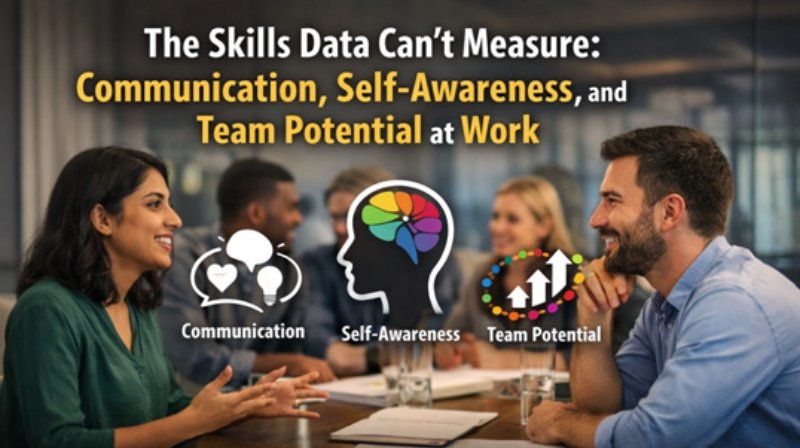
In many organizations, decisions are increasingly shaped by data. Performance dashboards, productivity metrics, and skills analytics all promise a clearer picture of how people and teams are doing. These tools can be useful. They show output, speed, completion rates, and patterns that might otherwise be missed.
But they do not tell the whole story.
Some of the most important drivers of team success are still difficult to measure: communication, emotional awareness, adaptability, trust, and the ability to work well with other people. These qualities rarely appear neatly in a dashboard, yet they influence collaboration, leadership, and long-term performance every day.
A technically skilled employee who struggles to communicate clearly, handle conflict, or work constructively with colleagues can slow a team down without meaning to. On the other hand, people with strong interpersonal skills often hold teams together. They reduce friction, create clarity, and help others perform better.
This article looks at the capabilities that data alone cannot fully capture, especially communication, self-awareness, and team potential, and explains why organizations need to invest in them alongside technical expertise.
The Foundation of Strong Workplace Communication
One of the most underestimated drivers of workplace performance is clear communication. Even highly capable teams lose time and momentum when expectations are vague, messages are misunderstood, or important context is missing.
That is why many organizations invest in workplace communication training. Done well, this kind of training helps employees express ideas more clearly, listen more actively, and navigate discussions with greater confidence and precision.
Good communication training is not only about speaking and writing. It also covers tone, timing, context, and nonverbal signals. It helps people understand how their message is received, not just what they intended to say.
As communication improves, so does coordination. Employees feel more comfortable sharing ideas. Managers give clearer guidance. Disagreements are addressed earlier, before they grow into larger problems. Over time, communication becomes more than a soft skill. It becomes a real performance advantage.
Understanding Personality to Improve Team Collaboration
Every team includes people with different communication styles, motivations, and ways of making decisions. Those differences are normal, but when they are not understood, they can create avoidable tension.
This is one reason many companies use tools such as an insights discovery personality assessment. Used thoughtfully, these assessments give teams a structured way to reflect on behavioral preferences and working styles.
The goal is not to put people into boxes. It is to help colleagues understand why someone may process information differently, prefer a certain style of communication, or respond to pressure in a particular way.
When teams build that kind of awareness, collaboration often gets easier. People learn to adapt their communication, interpret each other more fairly, and value different perspectives instead of seeing them as obstacles. In many cases, what once felt like a personality clash turns out to be a difference in style.
Why Data Alone Cannot Capture Human Potential
Performance data matters, but it only reflects part of what makes someone valuable at work. Numbers can show how quickly projects are completed, how many tasks are closed, or how often targets are met. What they usually cannot show is whether someone makes others better, calms tension in difficult moments, encourages honest discussion, or brings energy to a struggling team.
Two employees may look very similar on paper. Both may hit deadlines and produce strong results. Yet one may also create trust, strengthen collaboration, and help the team stay resilient under pressure. The other may work well individually but create friction around them. Standard performance metrics rarely tell that story clearly.
Organizations that understand this gap start paying more attention to behavior, relationships, and team dynamics. They recognize that human potential is not only about technical skill. It is also about the effect a person has on the people around them.
The Role of Self-Awareness in Professional Growth
Self-awareness is one of the most important but least visible drivers of professional growth. People who understand their own tendencies are better equipped to adjust how they work, communicate, and lead.
For example, a manager who realizes they tend to dominate discussions can make a conscious effort to create more space for others. An employee who knows they react defensively to feedback can learn to pause, listen, and respond more constructively.
That kind of awareness makes development easier. People become more open to feedback because they understand their own patterns more clearly. They are also better able to adapt their behavior when a situation requires it.
Over time, self-awareness supports a stronger learning culture. Instead of treating feedback as a threat, people begin to use it as information.
Building Trust and Psychological Safety
One of the strongest indicators of team health is psychological safety — the shared belief that people can speak honestly without being embarrassed, ignored, or punished.
In teams with psychological safety, employees are more likely to ask questions, raise concerns, admit mistakes, and contribute ideas. Those behaviors matter because they improve both learning and execution.
Communication and self-awareness both play a major role here. Leaders who listen carefully, respond respectfully, and remain open to other perspectives create conditions where trust can grow. Employees who feel heard are usually more engaged, more collaborative, and more willing to contribute fully.
Trust also improves how teams respond to challenges. Instead of avoiding difficult conversations, people address problems earlier and work together to solve them.
Unlocking the Hidden Potential of Teams
Most teams have more potential than they currently use. In many cases, the real barrier is not a lack of technical ability. It is a lack of clarity, understanding, and connection between team members.
When organizations invest in communication development, personality awareness, and stronger collaboration habits, they create conditions in which people can do better work together. Employees begin to understand how others operate, where strengths complement each other, and how to contribute more effectively as a group.
This kind of change does not happen overnight. It takes leadership attention, consistency, and a willingness to treat human skills as seriously as technical performance. But the payoff can be significant: stronger teamwork, higher engagement, and better long-term outcomes.
Conclusion
Data and analytics have become essential in modern workplaces, but they cannot fully explain what makes teams successful. Listening, self-awareness, empathy, and collaboration remain deeply human skills, and those skills shape how people work together every day.
Organizations that recognize the value of these less measurable capabilities often gain an important advantage. By investing in communication, encouraging self-reflection, and building awareness of personality differences, they make it easier for teams to work with trust, clarity, and purpose.
The strongest teams are not only technically capable. They are connected, self-aware, and able to communicate in ways that bring out the best in everyone. At Disquantified.com, we believe that true creativity starts with the heart. And when shared with purpose, it can leave a lasting mark.