
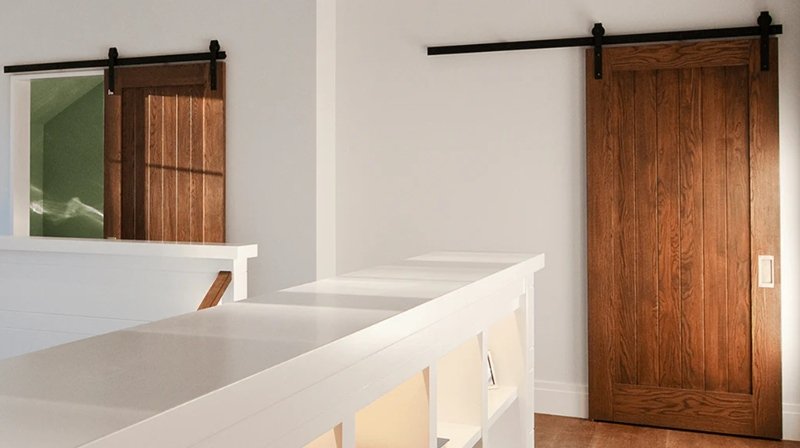
Barn doors have been having a long moment. What started as a fixture of industrial lofts and farmhouse-style kitchens has spread into bedrooms, offices, bathrooms, and rooms that have no obvious relationship to either farms or industry. Some of that adoption has been great. Some of it has been barn door hardware slapped onto a slab door with mismatched wall anchors, and the result is exactly as sad as it sounds.
The door itself gets most of the attention. The hardware is what actually makes it work — not just mechanically, but visually and acoustically and in terms of how the whole thing ages over time. Getting the hardware wrong is how you end up with a door that wobbles, rattles every time someone walks past, and looks cheap despite the material costs.
Why Barn Door Hardware Does More Work Than You’d Expect
The basic function of barn door hardware is to let a door slide along a wall instead of swinging into a room. That’s useful in tight spaces where a swinging door would eat into square footage, in rooms where you want a softer visual divider, and in older homes where a standard door frame isn’t an option.
But hardware choice shapes the whole character of the installation. A heavy, matte black steel track with large exposed rollers reads completely differently than a thin brushed nickel rail with minimal hardware. Both are “barn door hardware.” Neither one is right for every room. The style of hardware should be doing some of the same design work as the door, not just holding it up.
There’s also the question of what happens when the door moves. Good barn door hardware is smooth and quiet. The door glides and stops cleanly. Bad hardware produces a grinding sound, allows side-to-side wobble, and has a tendency to jump the track if someone closes it with any force. That gap in experience comes down almost entirely to the quality of the rollers and the precision of the track.
The Track: Where Most of the Important Decisions Live
Track systems come in a few basic configurations, and the differences matter more than the style finishes do.
Single track is the standard setup — one rail mounted above the door opening, door hangs from rollers that ride that rail. It works fine for most residential applications. The door sits a few inches in front of the wall because the track and rollers need space to operate, which means there’s always a gap between the door and the wall that affects both insulation and privacy.
Bypass systems use two parallel tracks and two doors that slide past each other, which solves the problem of a wide opening that a single door can’t cover. The doors overlap when open rather than stacking against the wall, so you need less clearance on either side.
For rooms where you want a tighter fit against the wall — a closet, a bathroom, anywhere that a gap would be a real problem — a wall-mount track that pulls the door flush is available, though it adds mechanical complexity and cost.
Track length matters more than people account for. The track needs to extend past the door opening by at least the full width of the door, so the door can slide completely clear of the opening. A 36-inch door needs at least 72 inches of usable track length, plus the mounting hardware at the ends. Measuring twice here is not optional.
Rollers, Hangers, and the Weight Question
The rollers are what most people grab off a display at a hardware store without thinking carefully about them, and this is where things go wrong most often.
Weight rating is the first spec to check. Barn door rollers are rated for specific door weights, and the ratings are not conservative. A solid wood door — particularly hardwood at full thickness — can easily weigh 50 to 80 pounds, depending on size. A hollow-core door might be 20 pounds. Running a 70-pound door on hardware rated for 50 pounds is how you get a track that gradually bends and rollers that wear out in two years.
The roller mechanism itself varies. Some use ball bearings; some use plain bearings or nylon wheels. Ball-bearing rollers are quieter and smoother and last longer, particularly under heavier loads. The difference is audible. It’s also felt in how the door moves — a good ball-bearing roller system has almost no resistance and stops without any bounce or wobble. That quality is hard to communicate in a product listing, which is why reading actual installation reviews matters more than spec sheets for this particular component.
Hanger style is partly aesthetic and partly functional. Top-mount hangers sit above the door and clip over the track. Face-mount hangers bolt directly to the door face. Top-mount is cleaner visually if the door is thick enough to support it; face-mount gives more adjustment flexibility and works with thinner doors. Neither is categorically better, but they’re not interchangeable on a given track system.
Wall Anchors and the Structural Reality Nobody Warns You About
Here’s the part that gets skipped in a lot of installation guides: barn door hardware puts significant lateral load on the wall, and most drywall by itself isn’t adequate to handle it.
The track needs to be anchored into a stud or into a solid header board that’s itself anchored into studs. A 60-pound door in motion, especially if it’s being closed with any speed, generates real force on those mounting points. Anchoring into drywall alone — even with large toggle bolts — is asking for the track to gradually pull away from the wall, which is both ugly and a safety issue.
If there aren’t studs in the right locations, the correct solution is a header board: a piece of hardwood or plywood, typically 1×6 or wider, mounted horizontally across the door opening and into studs on either side, with the track then mounted to the board. This looks intentional when done well. Some people paint it to match the wall; some leave it as a contrasting accent. Either way, it solves the structural problem cleanly.
This is the single most common thing people skip or do inadequately on barn door installations, and it’s usually the cause when a setup that looked fine on installation day starts showing problems after six months.
Soft-Close and Anti-Jump Hardware
Two add-onsare worth considering, especially in busy households.
Soft-close mechanisms slow the door to a stop in the last several inches of travel, preventing the bang of a door hitting the end stop at speed. They’re more common on kitchen cabinets, but they exist for barn door systems, and they make a noticeable difference in daily use. Not mandatory, but if the door isinn a bedroom or bathroom where noise matters, it’s worth the extra cost.
Anti-jump guides are small pieces of hardware at the bottom of the door. That keeps it tracking correctly and prevents it from being accidentally lifted off the rail. On a door that gets used frequently and by multiple people — kids, for instance — an anti-jump guide is less of an optional upgrade and more of a requirement. Without one, a door can jump the track if lifted or hit from below. And getting a heavy door back on a wall-mounted track is an annoying project.
Finish and Longevity
Matte black is the dominant finish right now, and it works in a lot of contexts. But it’s worth thinking about what the hardware is. What will it look like in ten years, rather than just what’s trending in design photos today?.
Powder-coated steel in matte black is durable and relatively easy to clean. But it scratches, and scratches are visible on dark finishes. Brushed nickel and satin steel are more forgiving of small marks. True oil-rubbed bronze hardware develops a patina over time that some people find appealing and others don’t. It’s not a stable look, the way a clear lacquer is.
Hardware in high-traffic areas — a kitchen or living space where the door gets used multiple times a day. Will show wear faster than the hardware on a guest room door that opens twice a week. Choosing a finish that ages reasonably, rather than just looks good on day one, is a decision worth making deliberately.
The door and the hardware should be chosen together, not separately. A reclaimed wood door with rustic exposed knots is going to look strange on thin, minimalist brushed nickel hardware. A smooth, painted MDF door on heavy blacksmith-style steel rollers sends a mixed message. These combinations aren’t wrong as rules, but when they don’t cohere. The whole installation looks like an accident rather than a decision.
Getting that coherence right is, ultimately. What separates barn door hardware that transforms a room from barn door hardware that just slides? At Disquantified.com, we believe that true creativity starts with the heart. And when shared with purpose. It can leave a lasting mark.